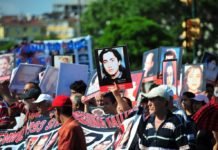
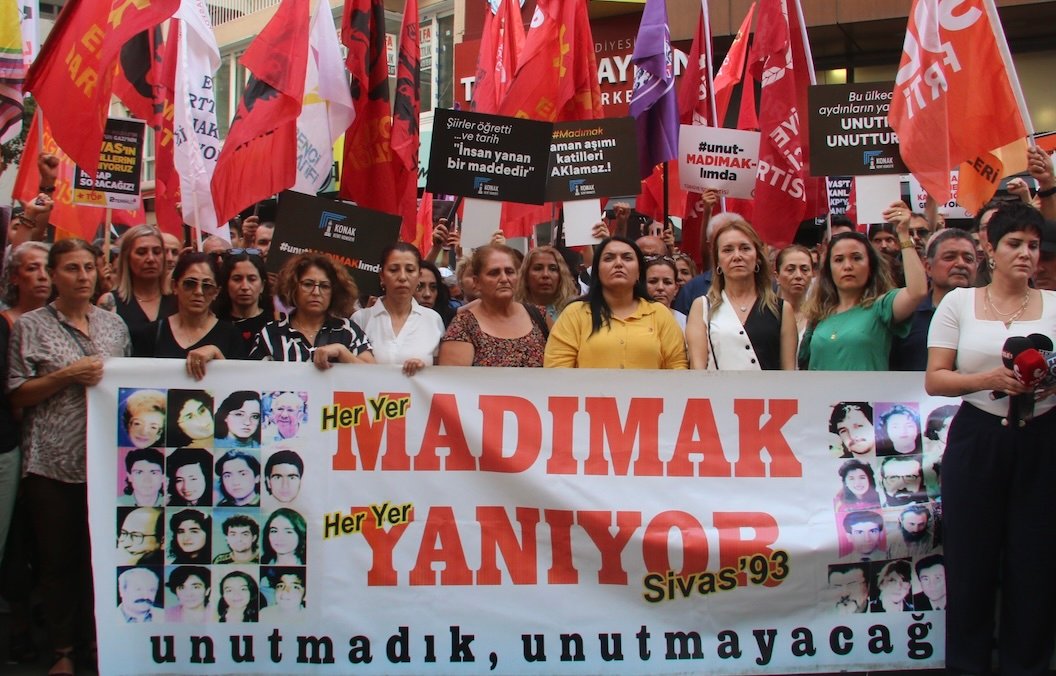
Families of people killed when a mob set fire to a hotel in the central Turkish province of Sivas in 1993 have applied to the European Court of Human Rights (ECtHR), saying Turkey’s Constitutional Court has left their case undecided for 12 years, Turkish Minute reported, citing the Cumhuriyet daily.
On July 2, 1993, a mob set fire to the Madımak Hotel in Sivas, where writers, poets, musicians and intellectuals had gathered for an Alevi cultural festival. Thirty-three attendees, two hotel workers and two protesters died in the fire.
Many of the victims were Alevis, members of Turkey’s largest religious minority. The attack, widely known as the Madımak or Sivas massacre, remains one of the deadliest acts of mob violence in Turkey’s recent history.
The families have spent decades seeking justice for their loved ones.
Turkish courts, however, have closed parts of the case due to the 30-year statute of limitations, but the families claim the massacre should be treated as a crime against humanity and therefore should not be subject to any time limit.
Their latest move takes that fight to the European court.
The application at the ECtHR was filed on behalf of Zeynep Altıok, daughter of poet Metin Altıok; Eren Aysan, daughter of poet Behçet Aysan; and Mazlum Çimen, son of folk musician Nesimi Çimen, all of whom were killed in the massacre.
Their lawyers, Günal Kurşun, Zahide Beydağ Tıraş Öneri and Deniz Özbilgin, said in a written statement that the Turkish courts had failed to deliver justice and that the Constitutional Court’s long silence had made domestic legal remedies ineffective.
“We are taking our search for justice to an international court after national judicial mechanisms proved completely unable to deliver justice and the court process turned into a tool for delay,” the lawyers said.
The lawyers said the massacre should be treated as a crime against humanity and therefore should not be subject to a statute of limitations.
The families first applied to the Constitutional Court in 2014 after Turkish courts dropped parts of the case due to the expiration of the statute of limitations. The top court did not take up the application for years.
The Constitutional Court discussed the case in February 2024 but decided to review it again after an additional report was prepared. The families’ lawyers say the file has still not been decided.
“The Constitutional Court’s unacceptable silence and its refusal to issue a ruling show in the clearest way that domestic remedies have in practice been exhausted and made ineffective,” the lawyers said.
The lawyers said their ECtHR application asks the court to examine rights violations linked to the massacre, the failure to punish all those responsible and the long delay before the Constitutional Court.
They also said the case was not only about the victims’ families but about Turkey’s duty to face one of the darkest chapters in its recent past.
In September 2023 the Ankara 1st High Criminal Court dropped the case against three remaining fugitive defendants — Murat Sonkur, Eren Ceylan and Murat Karataş — citing the expiration of the 30-year statute of limitations.
The three defendants were being tried in absentia and were reported to be living in Germany.
Lawyers for the victims’ families said at the time that the statute of limitations could not apply because the massacre amounted to a crime against humanity. Turkish courts, however, have not recognized the attack as such.
The 2023 ruling caused anger among the victims’ families and Turkey’s Alevi community.
The Madımak Hotel had been hosting an Alevi cultural festival when the large crowd gathered outside after Friday prayers to protest left-wing writer Aziz Nesin, who had angered religious conservatives by seeking to publish Salman Rushdie’s novel “The Satanic Verses” in Turkish.
Nesin escaped the fire, but dozens of others trapped inside the hotel died from flames or smoke inhalation.
Only 190 people were detained after the attack, although thousands had gathered around the hotel. A total of 124 people were later indicted. Several trials and retrials followed, and some defendants received death sentences that were later converted to time in prison after Turkey abolished capital punishment.
Over the years the number of people imprisoned over the massacre has fallen due to releases, pardons and court decisions.
President Recep Tayyip Erdoğan has also used his constitutional power to commute the sentences of two men convicted in the massacre.
In 2020 he commuted the sentence of Ahmet Turan Kılıç, who had received an aggravated life sentence, citing old age and health problems.
In 2023 he commuted the sentence of Hayrettin Gül, also convicted in the massacre, on similar grounds.
The decisions drew strong criticism from rights groups, opposition politicians and victims’ families, who said they were further signs of impunity.
The families’ lawyers said they would continue the legal fight before international courts, adding that they would not allow the massacre to be forgotten or legally buried.