
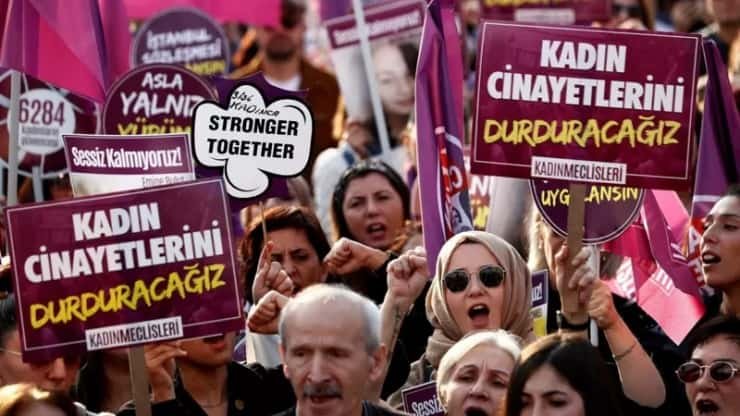
At least 150 women were killed by men in Turkey in the first six months of 2026, most of them in their homes and by current or former partners, the ANKA news agency reported, citing new data from the We Will Stop Femicide Platform (KCDP).
Another 151 women died under suspicious circumstances during the same period, the platform said Monday at a news conference attended by families campaigning for justice in femicide cases.
Of the 150 women killed, 92, or 61 percent, were killed at home. Ninety-five were killed by a husband, boyfriend or former partner, with husbands responsible for 64 of the deaths.
Other perpetrators included fathers, sons, brothers, relatives and acquaintances, showing that the women were overwhelmingly killed by men they knew rather than strangers.
The platform said women were frequently targeted when they attempted to exercise control over their lives by seeking a divorce, ending a relationship or escaping violence.
Seventeen women were known to have been killed after making decisions about their personal lives, while economic disputes were cited in 11 cases. The motive could not be established in 117 killings.
“The issue is not merely financial hardship; it is an attempt to control, silence and punish women,” the platform said.
Firearms were used in 78 murders, while 37 women were stabbed, 15 were strangled and seven were beaten to death. The platform said the prevalence of firearms showed the need for tighter controls on individual gun ownership.
In 50 cases another person was killed or injured during the attack, including children, relatives, friends, neighbors and people who attempted to intervene.
Protection orders failed to prevent killings
Eight women were subject to protective or precautionary measures under Law No. 6284, Turkey’s principal legislation against domestic violence, when they were killed.
Nine victims were going through divorce proceedings, four had filed complaints with police or prosecutors and three had both sought a divorce and lodged a formal complaint.
The platform said the cases demonstrated that protective measures must be implemented quickly and effectively rather than remaining on paper.
Information was unavailable about whether 138 of the victims had been under protective measures or whether 134 had previously filed complaints, pointing to significant gaps in the available records.
At least 68 of the women killed had children and two were pregnant. Nine victims were under 18 and 10 were 66 or older.
The platform also recorded 151 suspicious deaths of women between January and June. Twelve deaths previously classified as suspicious were subsequently determined to have been femicides.
In 92 percent of the suspicious deaths, the relationship between the victim and a possible suspect was unknown. The cause or circumstances of death could not be established in 61 percent of the cases.
The KCDP said investigators should not hastily classify women’s deaths as suicides, accidents or unexplained incidents without examining previous threats, complaints and histories of violence.
“Stopping femicide requires focusing not on the perpetrators’ excuses, but on women’s right to life,” the group said.
The 150 killings represent an increase from the 136 recorded in the first half of 2025 but remain below the 205 reported during the same period in 2024.
The platform documented 294 femicides and 297 suspicious deaths of women in all of 2025.
Turkey does not regularly publish comprehensive nationwide femicide figures, leaving women’s organizations to compile data from media reports, court records and information provided by victims’ families.
Withdrawal from Istanbul Convention
The report comes five years after Turkey withdrew from the Istanbul Convention, a Council of Europe treaty requiring governments to prevent violence against women, protect victims and prosecute perpetrators.
Turkey was the first country to sign and ratify the convention, which was opened for signature in İstanbul in 2011. President Recep Tayyip Erdoğan announced the withdrawal by presidential decree in March 2021, with it taking effect on July 1 of that year.
Erdoğan’s government claimed the convention had been used to normalize homosexuality in a manner incompatible with Turkey’s “social and family values.” It maintains that Law No. 6284 and other domestic measures provide sufficient protection.
The government says it follows a “zero tolerance” policy toward violence against women and points to shelters, electronic monitoring, violence prevention centers and the KADES emergency application. Erdoğan has described violence against women as “a betrayal of humanity.”
Women’s rights groups say the withdrawal weakened prevention and accountability mechanisms and sent a message of impunity to perpetrators. They also criticize the government’s emphasis on traditional family structures, arguing that it prioritizes preserving the family over women’s safety and autonomy.
Erdoğan declared 2025 the “Year of the Family,” promoting marriage, childbirth and traditional family values. The KCDP said such policies risk confining women to domestic and caregiving roles while ignoring that the home is often the most dangerous place for them.
This article is republished from Turkish Minute.